
Finance Minister Nirmala Sitharaman on Thursday announced a Rs 11.11 lakh crore spending on infrastructure and vowed to continue reforms as she resisted resorting to populist measures in Modi government's last Budget before general elections, instead choosing to stay on the path of cutting deficit while bolstering measures for focus groups.
The company's planned capex for 2019-2020, which was Rs 12,000 crore, has now been revised down to around Rs 8,000 crore.

Notwithstanding expectations of a pick-up in construction activity during a seasonally strong January-March quarter (fourth quarter) of 2022-23 (FY23), analysts are cautiously optimistic about the building material sector - encompassing paints, pipes, wood panels, tiles, metals, and cement - as volatile input costs, coupled with fears of a global slowdown, are making demand projections uncertain. Against this backdrop, analysts suggest investors stay selective and pick stocks of companies with stronger brand recall, expanding distribution network, diversified product profile, healthier balance sheet, and sustainable cash flow. "The government's various proposals under Budget 2023-24 (FY24) may lead to the building material segment growing between 8 per cent and 12 per cent for the next five years.

Announcing the bi-monthly monetary policy, Reserve Bank of India Governor Shaktikanta Das said the RBI's internal survey says manufacturing, services and infrastructure sector firms are optimistic of the business outlook.

Bharat Heavy Electricals Ltd (BHEL) is India's largest engineering and manufacturing enterprise, operating across energy, industry, and infrastructure sectors. The investment path for the stock is based on a large order backlog, continued strong order inflows, and rising power demand, which should push demand for BHEL's equipment and services. BHEL has historically held over 70 per cent market share in power projects.
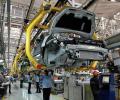
Automobile manufacturers are likely to report strong numbers for the September quarter of Financial Year 2023-24 (Q2 FY24), riding on growth across segments and offset by a marginal drop in overall two-wheeler (2W) volumes. Higher average selling price (ASP) year-on-year (YoY), which was necessitated by price hikes taken by original equipment manufacturers (OEMs), and an improved product mix will also aid revenues and margins. Moreover, commodity prices are down on a YoY basis, leading to higher margins in earnings before interest, taxes, depreciation and amortisation (Ebitda).

As Indian Railways looks to avert the crisis like last summer, preparations are under way to stock up coal at thermal power plants. Much like February and March, thermal coal movement in April was 5 per cent higher than the previous year, data from the Ministry of Railways shows. While India prepares for a hot summer this year, 48.23 million tonnes (mt) of coal for thermal power plants was ferried by Indian Railways in April. The national transporter also moved about 500,000 tonnes--18.4 per cent-- more imported coal for power plants this April than it had done last year.

The Street's optimism on India's largest listed automotive maker by market capitalisation is not misplaced, given the robust wholesale performance in recent months and the strong 2023-24 (FY24) October-December (Q3) results.

India's economy is likely to grow by 12 per cent in 2021 following a 7.1 per cent contraction last year, as near-term prospects have turned more favourable, Moody's Analytics said. A stronger than expected December quarter GDP growth of 0.4 per cent following a 7.5 per cent contraction in the previous three months has turned India's near-term prospects more favourable, it said. Domestic and external demand has been on the mend since the easing of restrictions, which has led to improved manufacturing output in recent months.

In the July to September quarter of 2023-24 (Q2FY24), Voltas' revenues grew by 29.7 per cent year-on-year (Y-o-Y), but the adjusted net profit was down by 63 per cent Y-o-Y. The revenues hit Rs 2,290 crore, led by growth in the Unitary Cooling Products segment (up 15.4 per cent Y-o-Y, and in the EMP (Electromechanical project) business (up 66.8 per cent Y-o-Y). The UCP revenue rose to Rs 1,200 crore in Q2FY24, driven by volume growth despite weak consumer spending - the three-year annual growth is 18 per cent.

India's inclusion in JP Morgan's bond index can channel billions of dollars into India. How will the government securities market handle it?

Stressing that economic growth will only move upwards, the Reserve Bank of India Governor Shaktikanta Das on Friday pegged the GDP growth rate for the next financial year at 10.5 per cent, though a tad lower than the government's projection of 11 per cent. The projection is in line with the estimates in the Union Budget 2021-22 presented in Parliament earlier this week. The Economic Survey, tabled by the government in Parliament recently, has projected that the economy will grow at 11 per cent, up from an estimated historic decline of 7.7 per cent in 2020-21, on account of the COVID-19 pandemic.

While efforts are being mounted on a war footing to arrest its spread, COVID-19 will impact economic activity in India directly through domestic lockdown. The second-round effects, it said, would operate through a severe slowdown in global trade and growth.

The surge in export, domestic demand and public spending in infrastructure projects might revive private investment during 2017-18.

Siemens reported solid results in the July-September quarter (fourth quarter, or Q4) of 2022-23 (FY23), with the top line growing 25 per cent year-on-year (Y-o-Y) to Rs 5,808 crore. The operating profit margin stood at 12.1 per cent, led by lower employee costs and other operating expenses. The company follows the October-September financial year.

'Investors with higher risk appetite and longer horizon (more than one year) can invest in longer-duration funds like corporate bond funds, long-duration funds and gilt funds for maximum gain.'

The cement sector may be looking at better realisations and higher volume offtake going by the trends of the October-December quarter of the 2022-23 financial year (Q3FY23), a recent price hike, and the promise of a continued infrastructure thrust in FY24. In Q3, revenues rose by an aggregate of 17 per cent year-on-year (YoY), but Ebitda (earnings before interest, tax, depreciation and amortisation) per tonne, fell by 14 per cent YoY while profit after tax (PAT) rose by 23 per cent YoY. Expenses were up 30 per cent per tonne YoY - power and fuel costs in particular - and that's no surprise given the rise in fossil fuel prices.

'The cost of financing the fiscal deficit will decrease, as new passive investors join in.'

The tea industry's cup of woes brimmeth - scanty rainfall and pest attacks have dragged down production in May, prices are lower than last year, and demand from some export markets is muted. Production in North Bengal - comprising the Dooars, Terai, and Darjeeling - is majorly affected; parts of Assam are also hit. Arijit Raha, secretary general, Indian Tea Association (ITA), said that the Tea Board numbers for April show a crop loss of about 9 per cent for North Bengal, compared to last year.

While near-term performance is difficult to predict after a huge run-up, fund managers believe the PSU theme's prospects remain sound over the medium to long term.

After disappointing guidances in the first quarter (Apr-Jun) of the 2023-24 financial year (Q1FY24) and valuation downgrades, the Indian IT sector could see some positive repricing as the bad news for IT maybe easing in Q2FY24. A key negative factor was weaker demand from the US financial sector and from North America in general. The latest GDP (gross domestic product) estimates and sector-specific news suggest that the demand situation may not be quite so bad with a gradual recovery in tech spending in Q2.

Domestic commercial-vehicle (CV) sales volume will witness significant growth over the next few years and the overall CV volume is likely to reach close to 1-million units by FY24, a report said on Wednesday. The report by credit ratings agency Fitch Ratings also expects growing demand and the resultant rise in operating leverage to boost the profitability of the domestic CV-focused original equipment manufacturers after FY22, despite elevated production costs. A recovery in medium and heavy CVs from multi-year lows, along with sustained growth in light CV categories, will help overall CV volume to reach close to 1-million units by FY24 - the level of the last cyclical peak recorded in FY19, it said.

The S&P BSE Auto Index has been one of the biggest outperformers among sectoral indices over the past year with returns of 26 per cent. By comparison, the benchmarks - the National Stock Exchange Nifty50 and the S&P BSE Sensex - managed about 6-8 per cent during this period. Improving demand, falling raw material costs, and rising product realisations, led by the premiumisation of portfolios, have led to a revision of growth estimates and upgrades by domestic brokerages.

Make in India has few advantages and some disadvatnages too.

At 5 per cent, Mumbai is likely to witness the highest rise in residential prices in 2024, a report released on Wednesday said. New Zealand's Auckland will also see a price rise of 5 per cent. According to real estate consultancy Knight Frank's "Prime Global Cities Index", improving gross domestic product (GDP) figures, Mumbai's relative value and investment in infrastructure will be the prime influencers in pushing prices higher for the luxury housing market in the city.

Moody's expects macroeconomic policies to contribute to sustained robust growth.

Union Minister of Road Transport and Highways Nitin Gadkari on Tuesday unveiled the prototype of the world's first Bharat Stage (BS)-VI-compliant electrified flex-fuel car, developed by Toyota Kirloskar Motor. The car, which runs on 100 per cent ethanol (E100), is based on the Toyota Innova HyCross. It can cover 40 per cent of its distance on ethanol and the remaining 60 per cent on electric, with the petrol engine shut off.

Capital goods companies in their Q2FY24 results are expected to report another steady quarter of earnings growth as order inflows and execution remain healthy, according to analysts. An upward revision in order inflow targets and a margin improvement due to lower raw material costs are also anticipated. "We expect the execution of all capital goods companies and most EPC (engineering, procurement, and construction) companies to remain healthy Y-o-Y (year-on-year), led by strong order book accretion in the past 5-6 quarters," wrote analysts at Kotak Securities in a note, estimating revenue growth of 32 per cent for India's largest company in the capital goods space -- Larsen & Toubro.

The spike in food prices at the onset of the monsoon season has corroborated the Reserve Bank of India's (RBI's) view that the fight against inflation is far from over, the State of the Economy report of the central bank said. At the same time, the report said that the country is poised to become the fastest-growing major economy in the world, notwithstanding some sequential moderation in economic activity in June. Consumer Price Index (CPI)-based inflation rate increased to 4.8 per cent in June 2023, from 4.3 per cent in May, primarily on account of an increase in food inflation.

BCCI honourary secretary Jay Shah provived updates on the Asia Cup venue, WPL and India's preparations for the ODI World Cup.

Companies are back with their hiring plans as the economy shows signs of recovery with a boost in domestic demand.

The Telecommunications Bill, 2023, which was passed by a voice vote after a short debate, also allows the Centre to take possession of a telecom network in case of any public emergency or in the interest of public safety.

The Union Budget on Wednesday outlined several initiatives to drive India's technology agenda and boost digital infrastructure, including new centres of excellence for artificial intelligence, National Data Governance Policy, and Entity DigiLocker.

Eminent economist Arvind Panagariya has said India is on the cusp of returning to a high growth trajectory and voiced confidence that the country will become the world's third-largest economy by 2027-28. Currently, India is the fifth largest economy "so it's another five years.We are already in (the year) 2023. "So 2027-28, India should be the third-largest economy," Panagariya, Columbia University Professor and former Vice Chairman of NITI Aayog, told PTI in an interview in New York.

Positive cues from China - which accounts for 56.5 per cent of global crude steel production - are likely to keep demand-supply in balance and provide support to prices. All eyes have been on China, which opened after New Year holidays, as it was widely expected that prices would recover post-holidays after the weakness in January. Jayanta Roy, senior vice president, ICRA pointed out, barring last year when Covid-related restrictions affected China's steel demand in February 2020, historical trends show a typical upward movement in steel prices post-new year festivities. China's opening post-holidays was keenly awaited, especially in the wake of the sluggishness in the market in January.

Sales of commercial vehicles rose 8.59 per cent to 56,140 units in September, SIAM said.

Amazon Web Services (AWS) will invest nearly $4.4 billion (Rs 36,000 crore) in India by 2030 and support more than 48,000 jobs externally through a new regional service launched on Tuesday, said the on-demand Cloud computing company. AWS Asia Pacific (Hyderabad) is the company's second infrastructure region in India, six years after it opened its first Cloud region in Mumbai in 2016. The Hyderabad region will give customers access to AWS technologies for data analytics, security, machine learning, and artificial intelligence.

The recent surge in crude oil prices could shave off the gains made by India Inc in profit margins in the past few quarters. Worse, it comes at a time when consumer demand in the country is slipping and major global economies are witnessing a slowdown. A back-of-the-envelope calculation suggests that the margin expansion accounted for three-fourths of the rise in the listed firms' operating profit between the April-June quarter (Q1) of FY23 and Q1FY24, and only a quarter of profits gains came from revenue growth.

When Vineet Mittal first got into solar power, sometime around 2009, and was planting solar panels in Gujarat, renewable energy looked like a sector ripe for startups. Renewables were clearly the future of energy, and the big boys - Mukesh Ambani's Reliance, Adani Group, and the Tatas - were focusing much more on coal and petroleum. Little did Mittal know that things were going to change drastically.

The automobile sector is considered a good indicator of economic health. It has a very long value chain, from primary materials, like metals, glass and plastic, to value-added high-end electronic components, specialised alloys, and software.
